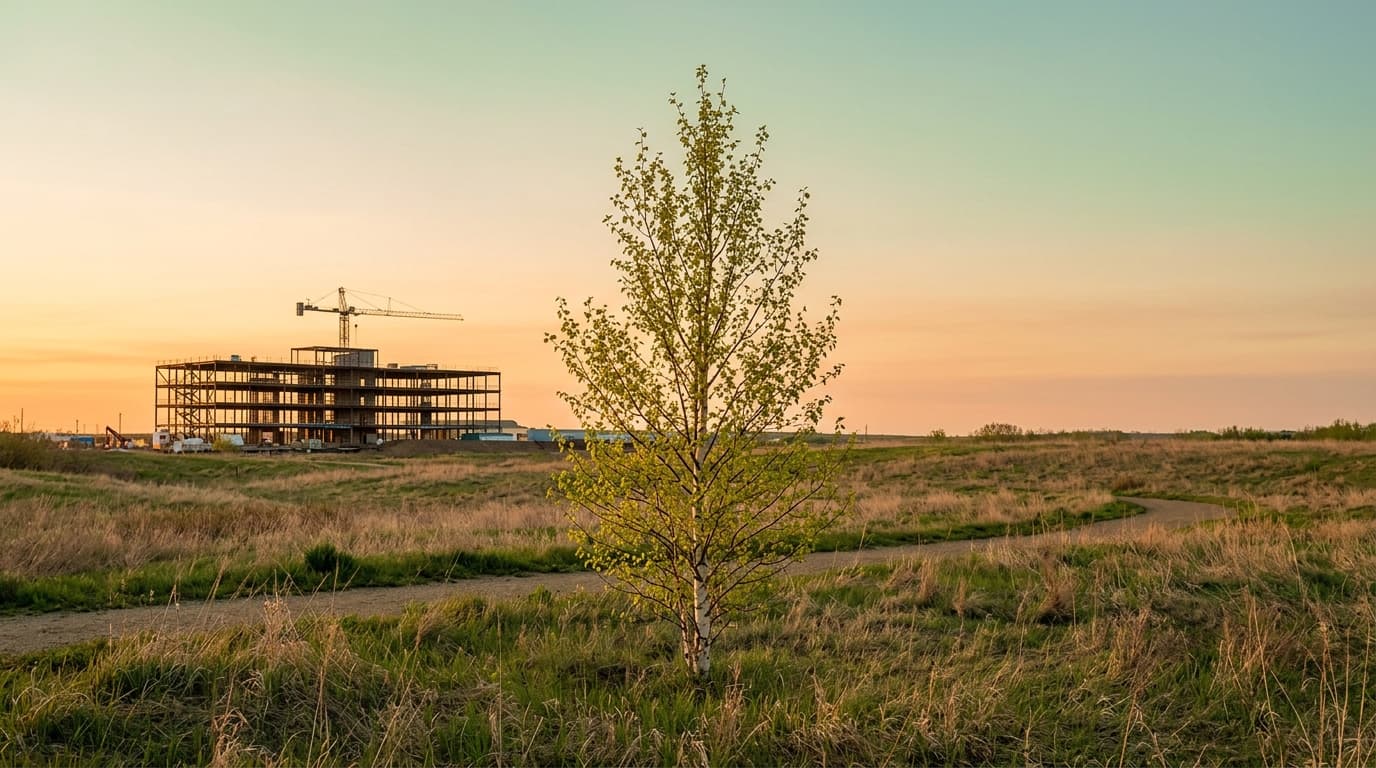
A $91-million housing project broke ground this month on a piece of Winnipeg land that Treaty One Nations spent over a decade fighting to get back. The development — 260 apartments, 109 of them at below-market rents — is the first major construction on Naawi-Oodena, the 109-acre site that was once Canadian Forces Base Kapyong. It is now Canada’s largest urban reserve.
The project is called Endayaan Omaa, which means “Home Is Here” in Anishinaabemowin. That name carries weight in a city where homelessness has nearly doubled in two years and First Nations, Métis, and Inuit people make up 80% of those without a place to sleep.
How Treaty One Got the Land Back
The story of Naawi-Oodena starts with a broken promise. When the federal government closed CFB Kapyong in 2004, it moved to sell the land in Winnipeg’s Tuxedo neighbourhood without consulting the First Nations who held Treaty rights to it. Treaty One — a coalition of seven First Nations in southern Manitoba — launched a legal challenge in 2008.
It took eleven years. A federal judge ruled in 2015 that the government had failed its duty to consult. The land transfer was finalized in 2019. Two years later, Treaty One named the site Naawi-Oodena — “centre of the heart” in Anishinaabe.
Now the first building is going up. According to CMHC, the federal government is investing $90.8 million through the Affordable Housing Fund, with Treaty One contributing $7.2 million in land equity and Efficiency Manitoba adding $765,000. Bockstael Construction is building it. Completion is targeted for 2028.
The 109-acre site has room for far more than one building. The master plan envisions roughly 5,000 homes alongside commercial, cultural, educational, and health facilities. Endayaan Omaa is the first piece — and it’s being built primarily by First Nations and Métis workers.
60% First Nations and Métis Workforce — Double the Requirement
The contract required 30% First Nations and Métis participation on the construction crew. The actual number on site is 60%. One in five workers is a Treaty One member specifically.
That matters beyond the headline. Construction is one of the few industries where a single project can create hundreds of jobs in a concentrated area over multiple years. When those jobs go to First Nations and Métis workers — many of them young adults — the economic impact stays in community. It’s self-determination made physical: First Nations, Métis, and Inuit people building First Nations and Métis housing on First Nations and Métis land.
The 109 below-market units will target students and families. The remaining 151 will be market-rate. It’s a mix designed to create a viable development, not just a subsidized one — housing that can sustain itself financially while still reaching people who need it.
Why 260 Units Isn’t Enough — and Why It Still Matters
Here is where the triumph meets the math. Winnipeg’s 2024 Street Census counted 2,469 people experiencing homelessness — nearly double the 1,256 counted in 2022. It was the highest number in the census’s ten-year history. Nearly 80% of those counted identified as First Nations, Métis, or Inuit.
Two hundred and sixty apartments will not close that gap. But Endayaan Omaa isn’t just 260 units. It’s proof that Indigenous-led development works — that a First Nations coalition can fight for land, win it back, plan a community, secure nearly $100 million in investment, and break ground with a majority-First Nations and Métis crew. That model is what scales.
The need is not abstract. Research published by the Homeless Hub found that nearly 50% of people experiencing homelessness in Winnipeg had involvement with the child and family services system. Most first became homeless at 18 — the age they aged out of care.
That pipeline is well-documented. Manitoba has 9,172 children in CFS care as of the most recent annual report — a 3% increase from the year before and the first notable jump since 2016-17. Ninety-one percent are First Nations, Métis, or Inuit. Manitoba’s Children’s Advocate, Sherry Gott, called the numbers “unacceptably high.”
Every year, hundreds of those young people turn 18 and transition out. Some access extensions of care. Many do not. Without stable housing, the path from care to homelessness is measured in months, sometimes weeks.
What Indigenous-Led Housing Actually Looks Like
The standard approach to affordable housing in Canada is government-funded, developer-built, and managed by a housing authority. Naawi-Oodena is different. The land is held by Treaty One. The vision is Treaty One’s. The workforce is predominantly First Nations and Métis. The project is named in Anishinaabemowin.
This matters because housing isn’t just shelter. For First Nations, Métis, or Inuit youth leaving care in Winnipeg, stable housing is the foundation everything else rests on — employment, education, cultural reconnection, community. Programs like New Steps and the growing network of transitional housing models across Manitoba exist because the system still pushes young people out the door before they’re ready.
Naawi-Oodena represents something upstream of that crisis: a community built by and for First Nations, Métis, and Inuit people, on land that was fought for and won. It doesn’t replace the need for transition supports, but it begins to change what’s available on the other side.
The 2024 Street Census recommended expanding transitional housing specifically for First Nations, Métis, and Inuit people relocating to Winnipeg — many of them young adults from northern communities. Endayaan Omaa’s 109 below-market units are a partial answer. The other 4,700-plus homes in the master plan are the longer one.
Two hundred and sixty homes on land that was almost sold out from under the people who held rights to it. That’s 2026 in Winnipeg. The need is enormous and growing. But so, for the first time at this scale, is the response — and it’s Indigenous-led development.
If you or a young person you know is navigating housing after aging out of care, reach out to our team. The work happens one young person at a time.